


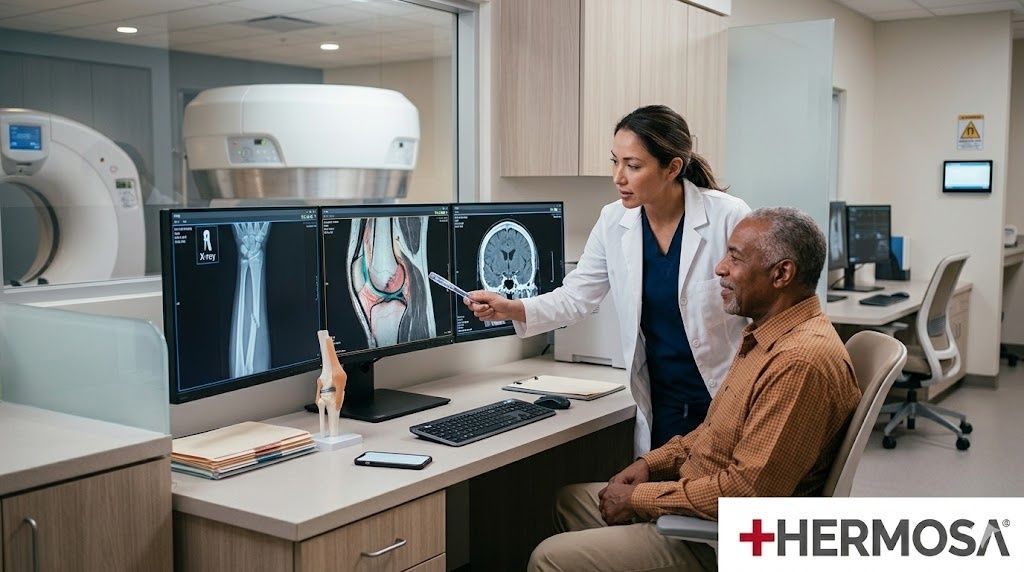
X-ray vs MRI vs CT Scan: How Doctors Pick the Right Test for Your Symptoms
X-ray vs MRI vs CT Scan: How Doctors Pick the Right Test for Your Symptoms
You walk into the doctor's office with a problem. Maybe it's a sharp knee pain that won't quit. Maybe a headache that's been hanging around for two weeks. The doctor listens runs an exam and then says you need imaging. But which one. Picking between X ray MRI and CT scan is one of the most common questions patients ask at our front desk every week and most of the time the answer comes down to what your doctor needs to see and how fast they need to see it.
Here's the thing. Doctors don't roll dice when they pick a test. There's real logic behind the choice and once you know that logic the whole process makes more sense. At Hermosa Medical Center on Pulaski Road in Chicago we've been ordering and running imaging for over 33 years and our on site Open MRI X ray and ultrasound mean most workups happen in one building.
So let's walk through how the decision actually gets made.
Reviewed by the Hermosa Medical Center Imaging Team
This article reflects how our imaging team coordinates with our cardiology internal medicine gynecology primary care and urgent care providers every day. Patients see us across all of those specialties and the imaging conversation is always tailored to the symptom not the test. Care happens in English Spanish and Arabic. For more on our on site Open MRI in Chicago see our diagnostic imaging page.
Why Your Doctor Picks One Test Over Another
This is where it all starts. Your doctor isn't shopping from a menu. They're matching the test to the question.
A broken bone needs a different answer than a torn ligament. A possible stroke needs a different answer than chronic back pain. So the doctor thinks about three things. What's the most likely cause of your symptoms. What test gives the clearest answer. And how fast do they need that answer.
The faster the answer is needed the more likely you'll get a CT scan. The more soft tissue detail is needed the more likely you'll get an MRI. The simpler the question the more likely you'll get an X ray.
That's basically the decision tree in one paragraph.
Diagnostic Imaging Explained Without the Jargon
Diagnostic imaging explained in plain English. It's any medical test that lets your doctor see inside your body without surgery. There are four common types of medical imaging tests you'll run into in everyday medicine.
X ray uses a small dose of radiation to take a quick black and white picture of bones and dense tissue. CT scan stacks many X rays together and creates a detailed cross section image of your insides. MRI uses a magnetic field and radio waves so no radiation at all and it shows soft tissue better than anything else. Ultrasound uses sound waves and gives a real time picture which is why it's the go to test for pregnancy and gallbladder issues.
That's the whole landscape. Everything else is just figuring out which one fits your situation.
How X-ray Works and When You'll Get One
How X ray works is pretty simple. A machine sends a controlled beam of radiation through your body. Dense parts like bone absorb the radiation and show up white. Softer parts like muscle let more radiation pass through and show up darker. A detector on the other side catches what made it through and turns it into an image.
The whole thing takes seconds. You stand or lie still. The technologist captures the picture from one or two angles. No IV. No contrast. No prep.
So when is X ray used in practice. Doctors reach for X ray when they suspect something dense or bony. That includes broken bones a possible pneumonia in the lungs joint problems like arthritis swallowed objects in children and any DOT physical that needs a chest X ray. It's also the first stop before more advanced imaging. If the X ray answers the question no further test is needed. If it doesn't you move up the ladder.
A small honest observation here. A lot of patients are surprised by how little they have to do for an X ray. It's the easiest part of any imaging workup.
When Your Doctor Steps Up to a CT Scan
CT scan enters the picture when your doctor needs more detail than an X ray can give and they need it fast. CT machines look like big doughnuts. You lie on a table that slides through the opening and the scanner spins around taking many X rays from different angles. A computer stitches those images into a cross section view that's far more detailed than a flat X ray.
The whole scan usually wraps up in under ten minutes. That speed is why emergency rooms run CT almost nonstop. Suspected stroke. Trauma. Internal bleeding. Kidney stones. A possible appendicitis. Tumor screening. All CT territory.
But here's the trade off. Radiation in CT scan vs X ray isn't even close. A single chest X ray delivers around 0.1 millisieverts of radiation. A chest CT delivers around 7. An abdominal CT can deliver 10. That's a real difference and your doctor weighs it before ordering.
For context the average person in the United States gets about 3 millisieverts of natural background radiation per year. One abdominal CT roughly equals three years of background exposure in a single scan.
That doesn't make CT dangerous. The benefit of a clear diagnosis almost always outweighs the radiation cost. But it's the reason MRI and ultrasound get picked first when they can answer the same question.
When MRI Becomes the Right Call
MRI takes longer than the other tests. Most scans run twenty to sixty minutes. The machine is loud and the bore can feel tight. But the image quality on soft tissue is something nothing else can touch.
MRI uses a strong magnetic field and radio waves. No radiation at all. That makes it the imaging test of choice for the brain spinal cord joints muscles ligaments and internal organs.
So when does your doctor pick MRI. Persistent back pain that hasn't improved with rest. Suspected nerve compression or disc herniation. Joint injuries like a torn ACL or rotator cuff. Headaches with neurological signs. Multiple sclerosis monitoring. Soft tissue tumors. Any condition where what's wrong is in the soft tissue not the bone.
If a tight scanner makes you nervous our Open MRI is built wider and feels much less enclosed than a typical hospital scanner. A lot of our patients who had cancelled MRI scans elsewhere finally got the answers they needed in our facility.
Ultrasound vs MRI
Ultrasound vs MRI confuses a lot of patients because both can image soft tissue. So why does the doctor pick one over the other.
Ultrasound is fast portable and uses sound waves which means no radiation and no magnet. The technologist holds a probe against your skin and the image shows up in real time on a screen. That real time aspect is huge. It's why ultrasound is the standard for pregnancy monitoring gallbladder evaluation thyroid nodules and bedside heart checks.
MRI gives much more detail than ultrasound especially for deep structures like the brain spinal cord and joints. Ultrasound can't see through bone or gas. MRI doesn't have that limitation.
A simple way to think about it. Need a fast real time look at one specific spot. Ultrasound wins. Need the sharpest possible soft tissue picture and time isn't the constraint. MRI wins.
The Difference Between MRI and CT Scan
The difference between MRI and CT scan is the question we hear most often. They look similar to patients. Both involve lying on a table that slides into a big machine. But under the hood they couldn't be more different.
CT scan uses X rays and a computer. It's fast and excellent for bones lungs organs trauma and emergencies. It uses ionizing radiation.
MRI uses a magnetic field and radio waves. It's slow and excellent for soft tissue brain spine joints and chronic conditions. It uses no radiation.
If your doctor needs a quick answer or you've had recent trauma CT is usually the right tool. If your doctor is investigating chronic pain nerve issues joint injuries or anything in the central nervous system MRI is usually the right tool.
There are also a few situations where either could work. Suspected appendicitis can go to CT or ultrasound. Cardiac imaging can use CT or MRI depending on what the cardiologist needs. Your doctor weighs accuracy speed cost and radiation before making the call.
MRI or CT Scan for Back Pain
Back pain is the imaging question we field most often at our Chicago clinic. So let's settle MRI or CT scan for back pain in plain language.
Most acute back pain doesn't need imaging at all. National guidelines say to try conservative treatment first. That means rest movement stretching and time. Four to six weeks of patience often solves the problem without any scan.
But when imaging is needed here's how the choice usually goes.
For suspected fractures the doctor starts with an X ray. CT can come next if the fracture needs more detail.
For nerve compression a herniated disc or sciatica MRI is the standard. You can't see those problems on X ray and CT shows them poorly compared to MRI.
For acute trauma like a fall or car accident CT is faster and gets the answer in minutes.
For post surgical evaluation where there's metal hardware in the spine CT often works better than MRI.
If you've had ongoing back pain that hasn't improved with conservative treatment ask your provider about MRI. Our primary care providers in Chicago and our imaging team coordinate this directly so you don't bounce between buildings.
Medical Imaging for Soft Tissue
Medical imaging for soft tissue is where MRI takes the crown. Soft tissue means anything that isn't bone. Muscle. Ligaments. Tendons. Cartilage. Internal organs. Nerves. Blood vessels. Brain matter. Spinal cord.
X ray sees almost none of this. CT sees some of it especially with contrast. Ultrasound sees a fair amount in real time. MRI sees all of it in detail no other imaging can match.
That's why MRI gets ordered for almost any soft tissue question that needs a clear answer.
Which Imaging Test Is Best for Common Problems
Patients often want a quick reference for which imaging test is best for their situation. Here's a table that shows the usual first choice based on what's going on.
| Symptom or Condition | First Imaging Choice |
|---|---|
| Suspected broken bone | X ray |
| Chest pain with breathing issues | Chest X ray |
| Persistent back pain no trauma | MRI |
| Acute back trauma | X ray or CT |
| Headaches with neurological signs | MRI |
| Acute stroke symptoms | CT first |
| Suspected appendicitis | CT or ultrasound |
| Kidney stones | CT |
| Pregnancy monitoring | Ultrasound |
| Gallbladder evaluation | Ultrasound |
| Thyroid nodule | Ultrasound |
| Knee or shoulder injury | MRI |
| Heart structure evaluation | Echocardiogram or cardiac MRI |
| Multiple sclerosis monitoring | MRI |
This isn't the final word for every patient. Your doctor will tailor the test to your history and exam. But it's a solid starting frame.
How Cost and Access Factor In
Here's a part most patients don't think about until the bill arrives. Imaging tests have very different prices.
| Test | Approximate Cash Price | Time Required |
|---|---|---|
| X ray | $100 to $400 | Minutes |
| Ultrasound | $200 to $700 | 15 to 30 minutes |
| CT scan | $300 to $1500 | Under 10 minutes |
| MRI | $400 to $3500 | 20 to 60 plus minutes |
With insurance most patients pay a copay or coinsurance after the deductible is met. At Hermosa Medical Center we accept Medicare Medicaid Blue Cross Blue Shield Aetna Cigna Tricare Wellcare and RR Medicare. Cash payments and CareCredit financing are also options. Our billing team verifies coverage before the scan and gives you a clear out of pocket estimate so the price isn't a surprise.
Common Mistakes Patients Make With Imaging
A few avoidable mistakes show up over and over.
- Skipping the X ray when a doctor recommends one and jumping straight to MRI which costs more and takes longer
- Forgetting to mention a pacemaker cochlear implant or surgical clips before an MRI safety screening
- Showing up to imaging with metal items like watches rings or underwire bras and having to remove them in the locker room
- Not fasting before an abdominal CT with contrast
- Searching imaging results on the internet before the radiologist's report is ready and self diagnosing into a panic
- Avoiding necessary imaging out of fear of radiation when the benefit clearly outweighs the dose
- Cancelling an MRI because of claustrophobia without asking about Open MRI options
The fix for most of these is the same. Talk to your provider before the scan.
Why Choose Hermosa Medical Center
Hermosa Medical Center has been part of the Chicago community for more than 33 years. Our diagnostic and imaging center on Pulaski Road brings X ray ultrasound Doppler EKG and on site Open MRI under one roof. You don't sit on a hospital waiting list. You don't drive across the city. And if your imaging surfaces something that needs follow up the next conversation happens in the same building.
Our radiology team works closely with our cardiology team and our internal medicine doctors our gynecologists and our urgent care providers. That coordination matters because imaging is rarely the end of a story. It's usually the start of one.
Benefits of Hermosa Medical Center
- On site Open MRI X ray ultrasound Doppler and EKG
- Walk in hours 9 AM to 5 PM at 2004 N Pulaski Road Chicago IL 60639
- 33 plus years serving Chicago families
- Care available in English Spanish and Arabic
- Most major insurance accepted
- Cash and CareCredit options for self pay patients
- Same day imaging in many cases
- Multi specialty care in one building including cardiology gynecology psychiatry and primary care
- On site pharmacy for after the appointment
- Transparent billing with cost estimates before the scan
Patient Experiences We See Often
Names changed and details kept general.
A construction worker from Belmont Cragin came in after a wrist injury at work. X ray within fifteen minutes showed a clean fracture. He walked out with a splint a treatment plan and a follow up scheduled before lunch.
A retired teacher had been managing chronic low back pain for two years. Conservative treatment hadn't worked. Her primary care doctor at our clinic referred her for MRI. The Open MRI revealed a herniated disc that finally explained her symptoms. Physical therapy started that month.
A young mother brought her son in for a suspected swallowed coin. A single chest X ray confirmed the coin was already past the stomach and safe to pass on its own. No emergency room visit. No CT. Done in twenty minutes.
A patient with new palpitations needed cardiac evaluation. Our team coordinated an EKG an echocardiogram and a cardiology follow up across a single afternoon rather than three separate appointments at different facilities.
These outcomes are why a multi specialty clinic with on site imaging matters in everyday healthcare.
Frequently Asked Questions
What's the main difference between MRI and CT scan?
CT scan uses X rays and computer reconstruction to image bones organs and trauma fast. MRI uses magnetic fields and radio waves to image soft tissue with no radiation. CT is faster and better for emergencies. MRI is more detailed for soft tissue.
When is X ray used?
X ray is the first stop for suspected broken bones lung infections joint problems and any dense tissue question. It's fast inexpensive and uses a small radiation dose.
Is the radiation from a CT scan dangerous?
A single CT scan delivers more radiation than an X ray but the risk is low for most patients. The diagnostic value almost always outweighs the radiation exposure when the test is medically appropriate.
Which imaging test is best for back pain?
For acute back pain conservative treatment is usually tried first. When imaging is needed MRI is the standard for nerve and disc problems. X ray and CT are used for fractures and acute trauma.
Can I get imaging without a hospital referral?
You can see one of our primary care or urgent care doctors who can order imaging directly. Our diagnostic and imaging services are all on site so you stay in one building from consult to scan to follow up.
How fast do I get my imaging results?
Most results are read by a radiologist within 24 to 72 hours. Urgent scans are read faster. Your ordering doctor will share the report and explain the findings.
Wrapping Up
These three tests aren't really a competition with each other. They're different tools for different jobs and your doctor picks the one that answers your specific question. Once you know how that decision gets made the process feels less mysterious.
If your provider has ordered imaging or you'd like to talk to a doctor who can order the right test for your symptoms our team is ready to help. Call 773 772 8876. Walk in 9 AM to 5 PM at 2004 N Pulaski Road. Or book an appointment online.
This article is for general health information and is not a substitute for personalized medical advice. To discuss imaging for your specific situation talk to your provider.
Follow Hermosa Medical Center
Facebook: https://web.facebook.com/Hermosa.Medical Instagram: https://www.instagram.com/hermosa.medicalcenter/